To guide our self-reflection process here, I have created a model that depicts several realms of the sexual self to remind us of what impacts our sexual development. The realms include Ancestors, Location, Time, Culture, the Social and Personal aspects of life including deeper inner world components like the mind, body, emotions, and spirit.
For those of you who are visual learners, I’m going to ask that you take a moment and grab a copy of the model from the show notes, or, you can take a moment and draw it out for yourself here.
(I have not included a description of the model in words here, but rather, the image):
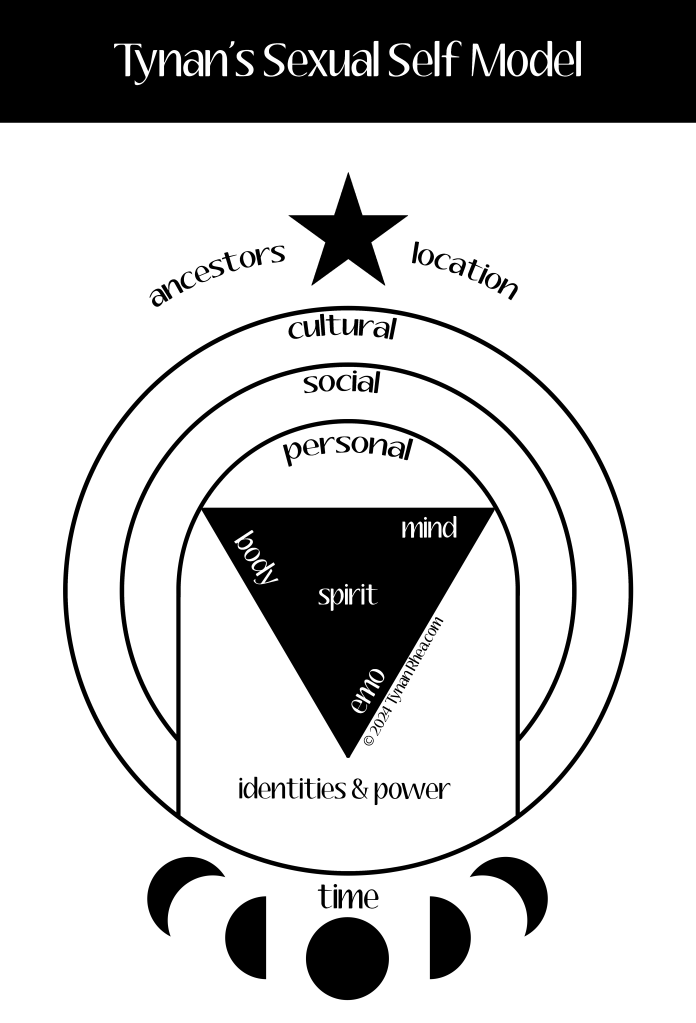
This model is based on the work of many psychotherapists, activists, philosophers, and artists before me. It started with an academic literature review and lay anecdotal stories & books of sex in pregnancy, labour, and postpartum from 1999-2015. Part of a project in my doula training, I specialized in sexual health during the reproductive years. I will not be going into detailed account of the research and literature that informs the model. Some people dedicate their entire life’s work in sexuality to working within one of the realms of this model. My life’s work is self-reflection. However, as we start to focus in on specific realms in the model, I will give you information on those who have inspired me and how their work informs the exercises I chose.
I will also say that this model, as a whole, reflects a kind of biopsychosocial model, a model created by George Engel. It is a medical model that was introduced into the field of allopathic western medicine when people noticed that there was a lack of acknowledgement for how psychological factors and social determinants of health impacted diagnosis and treatment. I appreciated how this model emphasized that biology, psychology, and societal factors could not be parsed apart. While they all require specific care and consideration, they all play-off each other and therefore cannot be considered as siloed components of a person’s health.
Now admittedly, for all that this model has been reflected in my own, the majority of my understanding of how psychology, society, and our inner world and external world intersect with each other was absolutely part of what I studied during my undergraduate studies in Sexuality, Marriage, and Family at St. Jerome’s college at the University of Waterloo.
Similarly, when I completed my training in Aromatherapy with Certified Natural Healthcare Practitioner Tracey Tief, I learned about the mind, body, spirit connection. Holistic medicine’s perspective on the interconnected nature of the mind, body, and spirit situates a person’s well-being as interacting and interconnected among these inner realms. This model explicitly includes the importance of spirituality and may even include energy-based aspects of being human. Energetic realms of the human experience have been taught to me in many ways. I am personally drawn to understanding energy in the body through a polyvagal theory perspective taught to me by Linda Thai in her Certification course and gained much knowledge through Noah Klozé’s Sex and Somatic workshop on how to apply many of these concepts in the context of sexuality and erotic play.
While the model shows the realms as distinct and separate, think of them more as component parts of a whole that is constantly interacting, influencing and being influenced, at all realms simultaneously.
I built this model to guide people through reflecting on specific questions about sexuality. For you, listener, this brief review is meant to facilitate initial insights about your sexuality that immediately arise for you without getting lost in the details of any particular realm, while giving you a kind of heads up about where we are headed over the next few episodes.
I will place a link in the show notes where you can access a picture of the model if you want to follow along.
THE REALMS
Ancestors & Geographical Location
The star at the top of the model, the North star, symbolizes our ancestors and geographical location. First, I’d like to talk to you about the importance of our ancestors.
Ancestors
We often see the light of stars long after they have burned out. It sits outside the circles and triangle in the middle of the model to symbolize ancestors existing outside of our corporeal plane. You may work within belief systems that do conceptualize ancestors as existing within the corporeal realm and I would encourage you to modify this model as needed to meet your needs.
Our ancestors offer:
- Stories of sexuality and sexual practices passed down through a family’s generations
- Epigenetic coding passed down through DNA
- Intergenerational sexual trauma
- Intergenerational sexual resilience and growth
- And they can be biological or cultural ancestors (e.g., queer and trans ancestors who may not share biological lineage but a cultural lineage: stories passed down through queer and trans community members throughout history)
Location
The large North star at the top of the model also symbolizes our location. Places we live in or frequently visit influence the cultures, society, and people we interact with. This contributes to our internalized beliefs, thoughts, feelings, and relationship to our bodies. Where we live includes the country, province, town, district, and neighbourhood. Our sense of self as it relates to land also influences our attitudes toward plants, animals, insects– every living thing. How we interact with our land shows quite a bit about how we live in our bodies and behave in our relationships.
Our location impacts:
- Access to resources for sexual and reproductive health
- Access to communities with similar identities as our own
- Access to communities with shared sexual interests (i.e., kink, polyamory, fetishes, etc.)
- It impacts how safe we are to express our authentic selves
- Access to clean drinking water, clean air to breath, clean food to eat, and therefore the functioning of all our body systems including reproductive organs
- Our understanding of the world and our place within it
Time
Time is represented by the moon phases at the bottom of the model. Time is a reminder that our attitudes about sex change over our lifetime; not just as individuals but as a society within cultural shifts, as well. Time is a reminder to think about whether you are reflecting on the present, the past, or the future you long for. Time is also not linear. Our past influences our future, our present influences how we story the past, our future urges certain choices in the present, and so on. Lastly, time reminds us that we will not live in this form forever, and in death, we do not have certainty of what comes next.
Time holds:
- Developmental stages or milestones in our sexual development
- The snapshot of our sexuality at any given moment
- The inevitability of change within sexuality
- The non-linear nature of how we see ourselves and move through the world
- The approach and awareness of our own death
Cultural | Culture
Culture is represented in the outermost ring of the model because it is the furthest ripple from our immediate experiences. Culture in this model refers to the customs, rituals, systems, expectations, beliefs, and assumptions about sex that exist within a space or community. Culture does not come from an individual though it can be perpetuated, validated, upheld, resisted, critiqued, or questioned by individuals.
Culture is informed by and perpetuated through:
- Pornography and erotic art
- Social services for sexual health
- Laws (attempting) to regulate sexual behaviour
- Religious teachings (attempting) to regulate sexual behaviour
- Art depicting sexuality
- Music depicting sexuality
- Hollywood depicting sexuality
- Books, articles, and news about sex and sexual health
- Advertising for sexual health products
- Advertising using sexuality to sell non-sexual products
- Social Media/Parasocial relationships
Social | Relationships
The social/relationships circle is closer to the personal realm because although it is still a ripple out from our individual experiences we can more immediately influence and be influenced by our social relationships. In this section, I am discussing interpersonal relationships (i.e., our relationship between ourselves and another), not intrapersonal relationships (i.e., the relationship with one’s self).
Relationships that may shape our sexual development include:
- Sexual and/or romantic partners
- Life partners
- Parents and caregivers
- Siblings
- Teachers and mentors
- Friends
- Colleagues and peers
- Neighbours
- Healthcare providers
- literally anyone we have contact with
Personal
The personal realm holds the boundary between our external experiences and internal world. This is why the personal realm exists both in a ring and with an embedded triangle point inward toward our internal experiences.
The personal ring recalls the sexual behaviours we have:
- Observed
- Requested
- Enacted
- Offered
- Received
- Sought
- Endured
- Survived
- Resisted
- Enjoyed
- Longed for
- Bragged about
- Hid
- Cried over in sadness and in euphoria
Mind
The mind is where the thinking happens. You are likely hearing or reading these words in your mind (or perhaps one day touching these words into thought). The mind is where our cognitive conception live. It is important to note that not all our thoughts are our own. Many (if not most) of our thoughts are internalized ideas from the culture, the social realm, or ancestral legacies.
The mind forms and deconstructs thoughts, beliefs, attitudes, judgements, and ideas about:
- Defining sex, sexuality, and the erotic
- The sex we have had or want to have
- Sexual partners
- Sexual expression
- Sexual acts/behaviours
- Sex with ourselves
- What sex or sexual partners are, are not, “should” be
- What sex or sexual partners are good, bad, neutral, or complex
Body
Bodies are the physical manifestation of our existence on earth. Bodies execute our movements through space, enact touch toward ourselves or others, and hold sensory memories of our experiences (often referred to as body-memories).
The body dictates our relationship to sex due to:
- Physical capabilities and limits
- Reproductive possibilities or impossibilities
- Autonomic responses of the nervous system
- Processing of sensory input
Emotions
What we call emotions are physiological changes in the body that we then interpret and label in the mind to ascribe meaning to a felt sense. Emotions provide synthesized information about our past or present sexual experiences to keep us safe. Sometimes this synthesis needs an update! But it is always based on something that was real at some point in time.
Emotions may influence our sexual self by:
- Providing information about what we like or do not like
- Overwhelming us with too much information at once
- Encouraging the body to protect itself
- Informing us about who we trust with our vulnerability
- Motivating us to explore and experiment
- Motivating us to hide and protect ourselves
- Signaling unmet needs, a lack of safety, or sexual wounding
- Signaling erotic fulfillment and values
Identities & Power
Identities & Power overlap the cultural, social, and personal realms to highlight their relationally created nature reflecting in-groups (those who hold power) and out-groups (those who are marginalized). Power matters because it dictates quite a bit about how we access safety. Whether we reject “labels” or not, the power of in-groups and out-groups based on how we look or act prevail. It’s also worth noting that who creates the label and who uses the label tells us a lot about who is hoarding power and who is trying to reclaim power.
Identities flag information about power and privilege as it relates to:
- Race
- Ethnicity
- Sexual orientation
- Relationship orientation
- Gender
- Reproductive abilities
- (Dis)ability
- Class/socio-economic background
- Citizenship
- Age
- Interests
- Politics
- Body size
Spirit
I’ve placed spirit at the center of the model to symbolize the meeting place of all the aspects of our sexuality converging into a cohesive understanding of who we are as sexual beings.
Spirit may or may not hold the following for you:
- The stories you tell yourself about who you are as a sexual being
- The stories you tell others about who you are as a sexual being
- Your sense of the purpose of the erotic in your life
- Your sexual self concept
Spirit is where we put all these pieces together.
EXERCISE
Now that we’ve reviewed the model, you can do your first short exercise. In this exercise I want you to either map out the model as you understood it (how it was described by me) or go take a moment and grab a copy of that model in the show notes (i.e., as depicted above). Once you have it, you can either recreate it by redrawing it or print it off for yourself.
What I’d like you to try is to highlight, colour, emphasize, which realms of this model are at the forefront of your mind and experience these days. While I appreciate (and I hope you appreciate now) that all of these pieces are influencing who we are as sexual beings, you might find that there is a particular realm that really wants your attention. For example, maybe some of the cultural messaging you got growing up is starting to repeat itself or really come to the centre stage of how you’re thinking of sex right now. And if that’s the case, you might want to start digging into what have I learned or have picked up along the way that is making me think the way that I think about sex, or myself, as a sexual being. Or maybe when we got to the intrapersonal relationship (the personal relationship you have with yourself) you thought, “oh my goodness, I really neglected this part of myself. I really neglected this part of my sexuality.”
So, just take a moment, highlight as many as you like or just one. This piece of paper, this little bit of insight, this little bit of data, keep it with you. As this might guide which episodes you want to skip to next, which episodes you might want to wait for, and it also might guide which episodes you want to skip for now. Maybe there was a realm that as I was describing it you thought, “oh gosh, that one’s gonna be a doozy… I think I might actually just straight up need a sex therapist for that one” and that’s okay too! See what jumps out at you.
In the next episode, I will be walking you through the realm of Time. I know I talked about Ancestors and Location realm first, but as I was putting together this podcast I realized that starting with Time, and specifically the exercise of creating a timeline, would really help ground us in our self-reflection work as we continue to go along. So, if you’re curious and your excited and your interested in learning more about how you are as a sexual being please join me in this next episode.
And if after this intro, you think there are people in your life that you think would really benefit from this podcast, please like, subscribe, and send this it to those people. I want everyone who wants this, who needs this, to be able to access this. Thank you so much for listening and I look forward to continuing to guide you through AuDSEX.


